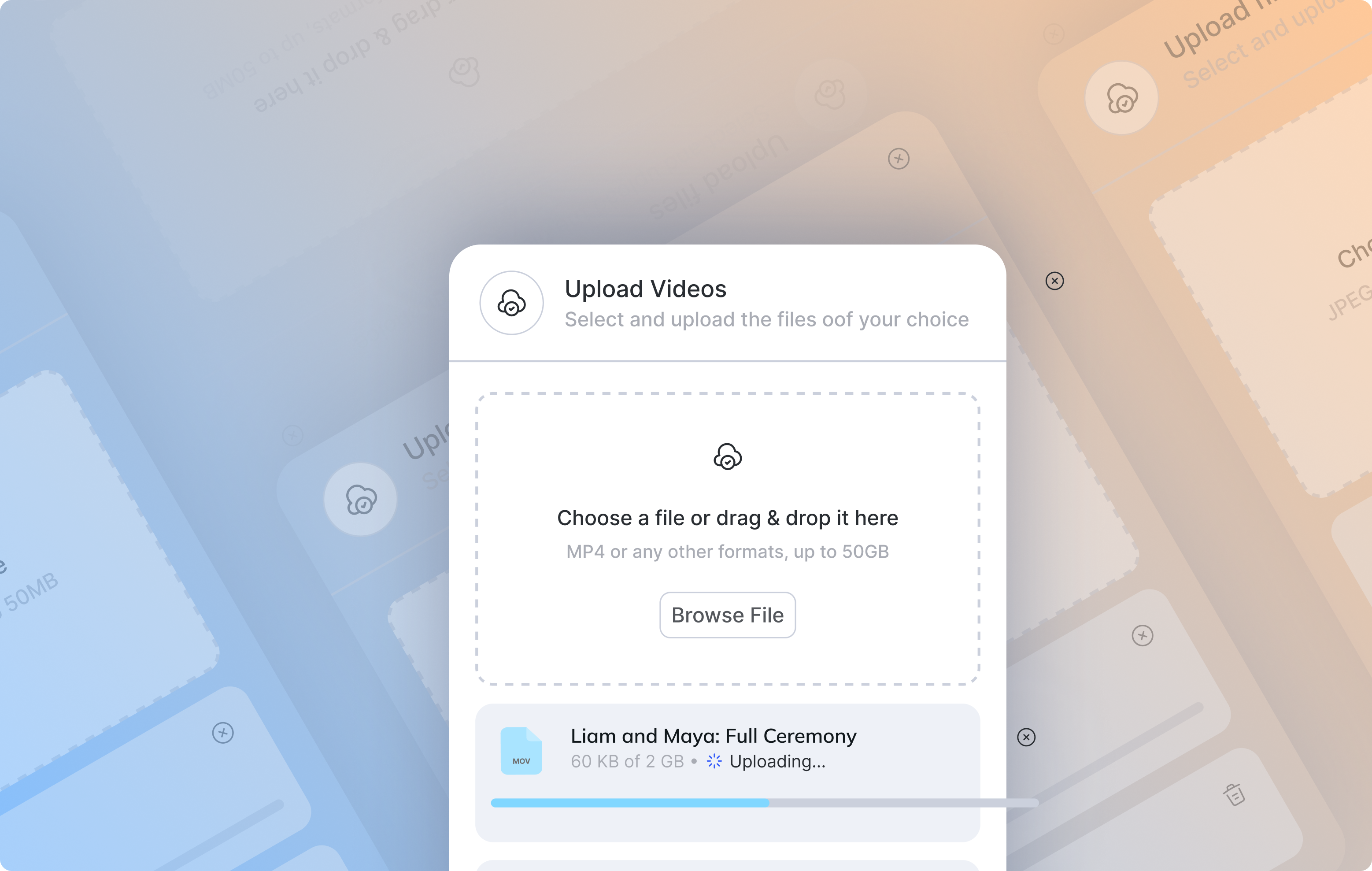
When a filmmaker exports a final wedding film, brand film, event film or client project, the file is often large.
Very large.
A final film can be exported in high resolution, with a high bitrate, detailed colour information and a file size that makes sense for archiving, download or professional delivery.
That file may look beautiful on your editing machine.
But that does not mean it is ready for smooth online playback.
This is where video transcoding matters.
Video transcoding is the process of converting a video file into one or more playback-friendly versions, so it can stream more smoothly across different devices, browsers and internet speeds.
For filmmakers, transcoding is not about reducing the value of the work.
It is about making the viewing experience better.
The original film still matters. The high-quality master file still matters. But the version used for streaming needs to be prepared properly, otherwise clients may experience buffering, slow loading, playback issues or failed viewing on certain devices.
A film should not only look beautiful.
It should play beautifully too.

What is video transcoding?
Video transcoding is the process of converting a video file from one format, size, bitrate or codec into another version that is easier to stream, watch and deliver online.
In simple terms, transcoding prepares your video for playback.
When you upload a large final video file, the platform can create different versions of that video. These versions may be smaller, more compressed or better suited for different devices and internet connections.
For example, a filmmaker might upload a high-quality 4K export.
A transcoding system can then create playback versions such as:
- A high-quality 4K streaming version
- A 1080p version
- A 720p version
- A lower-resolution version for slower internet
- Mobile-friendly playback versions
The viewer does not need to manually choose or download each file. The system can serve a suitable version depending on the device, connection and playback environment.
This is what helps the video feel smooth and responsive.
Transcoding vs original file: what is the difference?
The original file is the version you upload.
This is often your master export or final delivery file. It may be large, high-bitrate and created for quality, preservation or download.
The transcoded file is a playback-ready version created from the original.
It is designed to stream more efficiently online.
The important point is this:
A transcoded file does not need to replace the original file.
A good video delivery workflow should protect both needs:
- Keep the original quality file safe
- Create optimised playback versions for smooth viewing
For filmmakers, this is the balance that matters.
You want your clients to experience fast, reliable playback, but you also want the original final film to be preserved in its full delivered quality.
Why original quality playback can become a problem
Some services promote the idea that your video will play exactly as uploaded, in its original quality.
On the surface, this sounds good.
For filmmakers, "original quality" feels like a positive phrase. You have spent hours editing, grading, exporting and checking the final film. Of course you want the client to see it properly.
But online playback is not the same as file preservation.
A file that is perfect for download may not be perfect for streaming.
Original-quality files can be very heavy. They may have high bitrates, large file sizes and encoding settings that are not ideal for every browser, phone, tablet or internet connection.
This can lead to problems such as:
- Slow loading
- Long buffering times
- Playback stopping midway
- Poor performance on mobile
- Compatibility issues
- Heavy data usage
- Clients thinking the video is broken
- A less polished delivery experience
The film may be high quality, but the experience can feel poor.
That is the issue.
The goal is not only to preserve the file. The goal is to let the client watch it comfortably.
High quality does not always mean smooth playback
A common misunderstanding is that bigger files always mean better viewing.
For editing, exporting and archiving, a larger high-quality file can be important.
For online streaming, however, a huge file can create friction.
A 20GB wedding film may be suitable as a final downloadable master, but asking a browser to stream that file directly can be inefficient. Many clients will watch on Wi-Fi, mobile data, older phones, smart TVs, tablets or shared home connections.
Even if the file is technically beautiful, the client experience may suffer if the playback version is too heavy.
A professional delivery platform needs to understand the difference between:
- The file the filmmaker wants to preserve
- The file the client needs to stream
- The file the client may want to download
- The version that works best on their current device
This is why transcoding matters.
Why transcoding matters for filmmakers
Filmmakers care about image quality, sound, colour and pacing.
But clients care about the experience of watching the film.
If the film buffers every few seconds, the quality of the edit becomes harder to appreciate.
For wedding filmmakers especially, the first viewing is emotional. A couple may sit down together, open the gallery and prepare to relive the day. That moment should feel smooth, simple and uninterrupted.
Transcoding helps protect that experience.
1. Transcoding improves playback performance
The main reason to transcode video is to make playback smoother.
Instead of forcing every viewer to stream the original large file, the platform can play a version that is better suited to their connection and device.
This can reduce buffering, improve loading speed and make the viewing experience feel more professional.
For filmmakers, this means fewer client issues and fewer messages like:
"The video is not loading."
"It keeps stopping."
"It works on my laptop but not my phone."
"Can you send another link?"
A better playback workflow reduces friction for both the filmmaker and the client.
2. Transcoding makes video more accessible across devices
Clients do not all watch films in the same way.
One couple may watch on a MacBook.
Another may open the film on an iPhone.
A parent may watch on an Android phone.
A friend may open the link on a tablet.
Someone else may cast it to a TV.
Each device can behave differently. Different browsers and operating systems may support different playback conditions.
Transcoding helps make the video more accessible across a wider range of devices because the playback versions are prepared for online viewing.
The client does not need to understand any of this.
They just press play.
That is the point.
3. Transcoding helps with slower internet connections
Not every client has fast internet.
Even if the filmmaker uploads a beautiful high-quality file, the viewer's connection determines how easily that file can stream.
A heavy original file may work well on a fast office connection, but struggle on mobile data or slower home Wi-Fi.
Transcoded playback versions help the system deliver a more suitable stream.
This means clients with slower internet still have a better chance of watching the film without constant interruptions.
For destination weddings, family sharing and international clients, this becomes even more important.
A wedding film may be watched by relatives in different countries, on different connections, across different devices.
The delivery should be built for that reality.
4. Transcoding protects the emotional first viewing
The first viewing matters.
For a wedding film, this is often the moment the couple finally sees the story of their day come together.
They may watch it in the evening, with a glass of wine, on the sofa, after waiting weeks or months for the final edit.
If playback fails, buffers or becomes frustrating, it interrupts the emotional experience.
The client may still love the film, but the delivery has created friction at the exact moment that should feel effortless.
Transcoding helps make that first viewing smoother.
For wedding filmmakers, this is not just technical. It is emotional.
5. Transcoding makes delivery feel more professional
Professional delivery is not only about how the gallery looks.
It is also about how well it works.
A beautiful gallery with poor playback still creates a poor experience.
Transcoding supports the technical side of presentation. It helps the film load, stream and play in a way that feels more reliable.
For filmmakers building a premium brand, this matters.
Your delivery experience should feel as considered as your editing style.
Why "original quality only" is not always the best solution
Many filmmakers are naturally attracted to services that promise original quality playback.
That phrase sounds safe.
It sounds like the platform is respecting the work.
But original quality and playback quality are not always the same thing.
Original quality is important for the master file.
Playback quality is important for the viewing experience.
If a platform only focuses on the original upload and does not properly prepare the video for streaming, the result can be a file that is technically high quality but difficult to watch.
The client does not experience the film as a bitrate, codec or file size.
They experience it as a moment.
If that moment is interrupted by buffering, the delivery has failed.
A better approach is to preserve the original file while also creating optimised streaming versions.
That gives filmmakers both:
- The quality they need for final delivery
- The performance clients need for smooth playback
This is the approach Vyredo is built around.
Does transcoding reduce video quality?
Transcoding can reduce file size, but that does not automatically mean the viewing experience becomes worse.
A well-transcoded video is designed to balance quality and performance.
The goal is to create a version that still looks strong, but plays more smoothly online.
For most clients, a properly optimised playback version will feel better than an enormous original file that constantly buffers.
This is an important distinction.
A video that is technically higher quality but does not play smoothly may feel worse to the viewer than an optimised version that streams without interruption.
For filmmakers, the goal is not to make the file as small as possible.
The goal is to create the best possible viewing experience while preserving the original file separately.
Why the original file should still be kept
Transcoding is not a replacement for preserving the original final file.
The original export is still important.
It may be needed for:
- Client downloads
- Long-term storage
- Re-delivery
- Backup
- Archiving
- Future formats
- Proof of final delivery
- Higher-quality offline viewing
For filmmakers, the original file is the master version of the finished work.
It should not be discarded just because playback versions have been created.
A responsible delivery workflow should treat the original file as valuable.
That is why Vyredo keeps the original quality file and the transcoded playback versions as separate parts of the delivery system.
Vyredo Lite
Create a Lite Gallery for free
Use YouTube, Vimeo, Google Drive or Dropbox inside a branded Vyredo gallery. No expiry date on Lite Galleries.
Start with Vyredo Lite →How Vyredo handles transcoding and original files
Vyredo is designed to support both fast playback and original file preservation.
When a filmmaker uploads a video to Vyredo, the file is prepared for online playback through transcoding. This creates playback-ready versions that help clients watch the film more smoothly across devices and connections.
At the same time, Vyredo keeps the original quality file separately.
This means the uploaded master file is not simply replaced by the streaming version.
The goal is to give filmmakers a more complete delivery workflow:
- Optimised playback for the client
- Original quality file preserved separately
- A smoother viewing experience
- A more reliable delivery setup
- A professional gallery around the film
Vyredo also stores the original quality file and playback assets across two different cloud environments, helping support security, resilience and fast playback.
For filmmakers, this means the delivery is not dependent on one single version of the file doing every job.
The original file has one purpose.
The transcoded versions have another.
That separation is what makes the workflow stronger.
Why using two different cloud environments matters
For filmmakers, client files are important assets.
A wedding film or client film is not something that can be casually lost, overwritten or mishandled.
Using two different cloud environments can help create a more resilient delivery setup.
Instead of treating the uploaded film as one single asset in one single place, Vyredo separates the delivery workflow so the original quality file and playback versions can serve different purposes.
This supports two important needs:
1. Security and preservation
The original file should be kept safely.
It is the master version of the film and may be needed again in the future.
Keeping the original file separately helps preserve the filmmaker's final export and supports a more secure delivery structure.
2. Fast playback
The playback version should be optimised for the client.
It should load quickly, stream smoothly and work across devices.
By preparing separate playback versions, Vyredo can focus on the viewing experience rather than forcing the original file to do everything.
This is the difference between storage and delivery.
Storage protects the file.
Delivery creates the experience.
Vyredo is designed to handle both.
Why transcoding can take time
Transcoding is powerful, but it is not always instant.
Large video files need time to upload, process and prepare.
The larger the file, the longer this can take.
A short teaser may process quickly. A long wedding film, full ceremony or speeches film may take more time.
This is normal.
The system needs to receive the file, process it and create playback-ready versions. That preparation is what makes the final viewing experience smoother for the client.
For filmmakers, this is one of the trade-offs of professional video delivery.
You may wait longer during upload and processing, but the client receives a better experience afterwards.
Why upload tracking matters for filmmakers
Filmmakers are busy.
You may be editing another project, packing for a wedding, replying to enquiries, exporting another film or managing client communication.
You should not need to sit at your desk constantly refreshing a page just to check whether a video has finished uploading or processing.
Upload and transcoding can take time, especially with larger films.
That is why visibility matters.
A professional delivery workflow should let you track what is happening without forcing you to stop everything else.
Vyredo's QR upload tracking
Vyredo includes a QR code tracking function designed to make upload monitoring easier.
When your video is uploading or processing, you can scan a QR code and instantly check the upload queue from your phone.
You do not need to log in again on mobile.
You do not need to stay sitting at your desk.
You can scan the code, continue with your work and keep an eye on the upload progress from your phone.
This is useful when you are uploading larger wedding films, full ceremonies, speeches or multiple client videos.
The idea is simple:
Start the upload on your computer.
Scan the QR code.
Carry on with your tasks.
Check the queue from your phone whenever you need to.
For filmmakers, this small feature can make the delivery workflow feel less restrictive.
Why this matters in a real filmmaker workflow
A wedding filmmaker may be uploading:
- A 4K highlight film
- A full ceremony
- Speeches
- First dance
- A teaser
- A longer feature film
These files can be large.
The upload and processing stage may take time, especially depending on internet speed and file length.
Without proper tracking, the filmmaker may feel tied to the desk.
With QR upload tracking, Vyredo makes the process easier to monitor while you continue working.
This is not just a technical feature.
It is a workflow feature.
It recognises how filmmakers actually work.
Transcoding and client experience
Clients do not usually ask whether a video has been transcoded.
They do not ask what bitrate was used.
They do not ask about codecs, containers or playback versions.
They simply expect the film to work.
That is why transcoding is often invisible when done well.
The client opens the gallery, presses play and watches the film.
No confusion.
No download before viewing.
No waiting for a huge file to load.
No technical explanation required.
This is the goal of good video delivery.
The technology should disappear behind the experience.
Transcoding and brand perception
A filmmaker's brand is shaped by more than colour palettes, logos and website copy.
It is shaped by every interaction a client has with the business.
That includes delivery.
If the final gallery loads smoothly and the film plays beautifully, the experience feels polished.
If the film buffers, fails or takes too long to open, the experience feels less professional, even if the edit itself is strong.
This is why technical delivery affects brand perception.
A smoother playback experience supports a stronger brand experience.
For wedding filmmakers, this can influence:
- Client satisfaction
- Reviews
- Referrals
- Perceived value
- Trust
- Repeat bookings for other family events
- Word-of-mouth recommendations
The final delivery is often the last impression.
It should feel reliable.
Transcoding for wedding films
Wedding films are often longer and more emotional than other forms of video content.
A wedding filmmaker may deliver several different films to the same couple, including:
- Highlight film
- Feature film
- Full ceremony
- Speeches
- First dance
- Teaser
- Social media cut
Some of these files can be very large.
A full ceremony or speeches film can run for a long time, which makes smooth playback even more important.
If a 3-minute teaser buffers, it is annoying.
If a 45-minute ceremony buffers constantly, it becomes frustrating.
Transcoding helps longer videos become more manageable for online viewing.
For wedding filmmakers, this is essential.
Transcoding for commercial filmmakers and content creators
Transcoding also matters beyond weddings.
Commercial filmmakers, brand videographers and content creators often deliver videos to clients for review, approval, download or final use.
These clients may not be technically experienced.
They may be marketing managers, founders, agencies, venues, brands or social media teams.
They expect the delivery link to work.
A transcoded playback version helps make the process smoother and more accessible.
For any filmmaker delivering professional video online, transcoding helps bridge the gap between high-quality production and practical client viewing.
Video hosting vs video delivery
Video hosting and video delivery are related, but they are not the same.
Video hosting is where the file lives.
Video delivery is how the client receives and experiences the film.
A hosting system may store and play the video, but a delivery platform should think about the full client journey:
- How the video is uploaded
- How it is processed
- How it is presented
- How the client accesses it
- How the client downloads it
- How the filmmaker tracks delivery
- How the experience reflects the brand
Transcoding is one part of that delivery system.
It supports the playback experience, but it works best when combined with thoughtful presentation and clear client access.
What filmmakers should look for in a video delivery platform
When choosing a video delivery platform, filmmakers should look beyond storage space alone.
A good platform should help with both quality and experience.
Important things to consider include:
Transcoding, Does the platform prepare the video for smooth online playback, or does it simply try to play the original uploaded file?
Original file preservation, Does the platform keep the original quality file, or is the upload only converted into a compressed playback version?
Playback experience, Does the film load quickly and play well across devices?
Client gallery design, Does the delivery page feel professional and aligned with your brand?
Download options, Can clients easily download their final files?
Upload tracking, Can you monitor upload and processing progress without constantly refreshing your desktop?
Security and access, Can you control who opens the gallery?
Workflow fit, Does the platform work with the way you already deliver films?
A strong delivery platform should make the filmmaker's workflow easier and the client's experience better.
Common misconceptions about transcoding
"Transcoding means my video will look bad"
Not necessarily.
Poor transcoding can harm quality, but good transcoding is designed to balance visual quality and playback performance.
The goal is not to make the video look cheap.
The goal is to make it playable online.
"The original file is always best for streaming"
The original file is best for preservation and download, but not always best for streaming.
Large original files can cause buffering, slow loading and compatibility issues.
"Clients will notice if the playback version is not the original file"
Most clients notice whether the video plays smoothly more than they notice technical export details.
A smooth, high-quality playback version often creates a better experience than a heavy file that struggles to stream.
"I only need file storage"
File storage is useful, but it is not the same as client delivery.
A professional delivery experience also needs presentation, playback, access and clarity.
"Transcoding should always be instant"
Transcoding takes processing time, especially for larger files.
The time spent preparing the video helps create a smoother experience for the client later.
How to prepare videos before uploading for transcoding
Even when a platform handles transcoding, filmmakers should still export carefully.
Before uploading, check:
- The final edit is approved
- Audio levels are correct
- Colour export looks right
- The file plays correctly on your machine
- The file name is clean and client-friendly
- The correct resolution has been exported
- The correct film version is being uploaded
Transcoding can prepare the file for playback, but it cannot fix creative or export mistakes.
Always check the master before upload.
Suggested file naming for filmmakers
Use clean file names that make sense to the client and your own archive.
Examples:
Emma-and-Tom-Highlight-Film.mp4 Emma-and-Tom-Full-Ceremony.mp4 Emma-and-Tom-Speeches.mp4 Emma-and-Tom-Feature-Film.mp4
Avoid names such as:
final-export-v7-new-new.mp4 ceremony-final-final-actual.mp4 client-version-use-this-one.mp4
Clear naming keeps your delivery organised and professional.
The best approach: preserve the original, transcode for playback
The strongest video delivery workflow does not force you to choose between quality and performance.
It should do both.
It should preserve the original file for quality, download and security.
It should also transcode the video for smooth playback, accessibility and client experience.
This is the balance filmmakers need.
Original file for preservation.
Transcoded versions for viewing.
Branded gallery for presentation.
Clear download access for the client.
That is what turns video delivery from a simple file transfer into a professional experience.
Final thoughts
Video transcoding is one of the most important technical steps in modern video delivery.
For filmmakers, it helps solve a real problem: large original files are not always ideal for online playback.
A high-quality master file should be preserved, but the client should not be forced to stream a file that is too heavy for their device or connection.
Transcoding helps create playback versions that are smoother, faster and more accessible.
For wedding filmmakers, this matters because the first viewing is emotional. The couple should be able to press play and experience the film without technical friction.
Vyredo is built around this idea.
It helps filmmakers protect the original quality file while preparing the video for smoother playback. It also supports a more practical workflow with upload queue tracking through a QR code, so filmmakers can monitor progress from their phone without staying tied to their desk.
Because professional video delivery is not only about storing a film.
It is about making sure the film can be watched, experienced and remembered properly.
Further reading
- Video Delivery for Wedding Filmmakers: A Complete Guide
- How to Deliver Wedding Films Online Without Just Sending a Link
- What Is a Branded Video Gallery and Why Do Videographers Need One?
- YouTube, Vimeo or a Branded Gallery: What's Best for Client Video Delivery?
FAQ
What is video transcoding?
Video transcoding is the process of converting a video file into one or more playback-friendly versions. This helps the video stream more smoothly across different devices, browsers and internet connections.
Why does video transcoding matter for filmmakers?
Video transcoding matters because large original video files are not always suitable for online playback. Transcoding helps reduce buffering, improve compatibility and create a smoother viewing experience for clients.
Does transcoding reduce video quality?
Transcoding can reduce file size, but a good transcoding process is designed to balance quality and playback performance. The goal is to keep the video looking strong while making it easier to stream online.
Is original quality always best for video playback?
Original quality is important for preservation and download, but it is not always best for streaming. Large original files can be heavy, slow to load and difficult to play on some devices or slower internet connections.
Should filmmakers keep the original video file?
Yes. Filmmakers should keep the original quality file for download, backup, archiving and long-term delivery. Transcoded versions should be used for playback, while the original file should be preserved separately.
How does Vyredo handle video transcoding?
Vyredo prepares uploaded videos for smoother online playback through transcoding while also preserving the original quality file separately. This helps filmmakers support both client viewing and original file delivery.
Why can transcoding take time?
Transcoding can take time because the system needs to process the uploaded file and create playback-ready versions. Larger files, longer films and higher-resolution videos usually take longer to process.
How can filmmakers track uploads in Vyredo?
Vyredo includes a QR code upload tracking function. Filmmakers can scan the QR code and check the upload queue from their phone without needing to log in again or stay at their desk.
What is the difference between video hosting and video delivery?
Video hosting is where the video file is stored. Video delivery is the full process of presenting, sharing, streaming and giving access to the final film. Transcoding is one part of a professional video delivery workflow.
Is transcoding useful for wedding films?
Yes. Wedding films are often large and emotional, especially full ceremonies, speeches and feature films. Transcoding helps these videos play more smoothly online, creating a better experience for couples and their families.
Deliver your films with more intention
Create a free Lite Gallery with Vyredo and give your clients a better way to watch, share and download their films.
Create your free gallery →

